The Court of Arbitration for Sport (CAS) has upheld the appeal of the Senegal Football Federation (FSF), overturning the Confederation of African Football (CAF) Appeal Board’s decision to strip Senegal of the 2025 Africa Cup of Nations (AFCON) title and award it to Morocco.
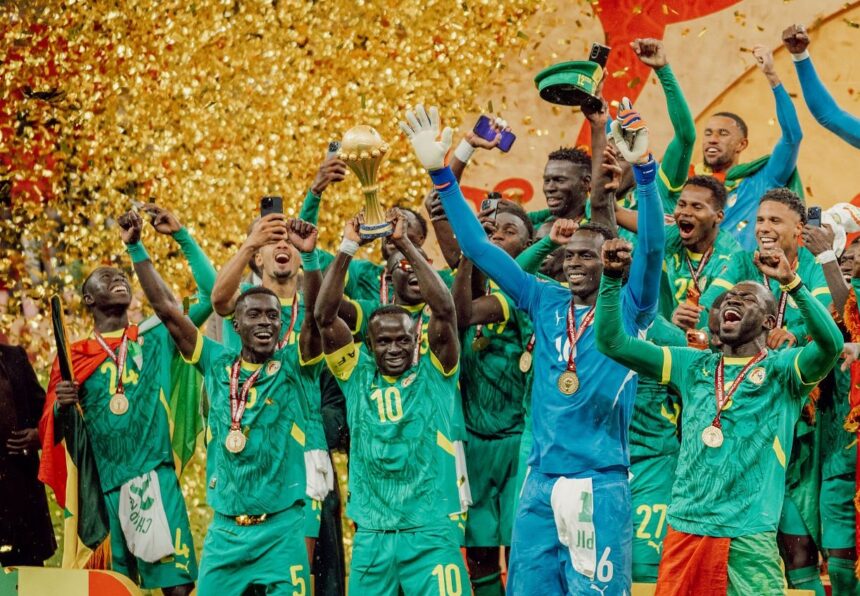
In a ruling delivered on Tuesday, CAS annulled the decision of the CAF Appeal Board and reinstated the earlier ruling of the CAF Disciplinary Board, confirming Senegal’s 1-0 victory over Morocco in the final.
The decision brings a major twist to the controversy surrounding the AFCON 2025 final, following CAF’s Appeal Board ruling that Senegal had forfeited the match and awarding Morocco a 3-0 victory.
Senegal had challenged that decision before CAS, arguing that referee Jean-Jacques Ngambo Ndala’s decision to resume the match in the 109th minute (90+19), after play had been interrupted, fell under the field of play doctrine and could not be overturned.
Morocco’s football federation, the FRMF, had argued that Senegal’s temporary walk-off from the pitch violated Articles 82 and 84 of the AFCON Regulations.
The Moroccan federation maintained that the referee should have abandoned the match and that his decision to allow play to resume was an error of law and arbitrary.
However, after examining submissions from both parties, the CAS panel ruled that the decision to resume or permanently abandon the match fell within the referee’s sole discretion.
“The decision of the referee to resume the match or to stop it definitively was a decision that fell within his sole discretion,” CAS stated.
The panel explained that by allowing play to resume, the referee had determined that the necessary conditions had been met, as both teams had returned to the pitch and expressed their willingness to continue the match.
“When the referee blew the whistle to resume play, he considered that the conditions for restarting the match had been fulfilled: both teams were once again present on the pitch and had both expressed their willingness to resume the match,” the CAS statement read.
Field of play doctrine protects referee’s decision
The panel further ruled that the consequences of the referee’s decision were limited to the field of play and therefore fell within the protection of the field of play doctrine.
“In the eyes of the Arbitration Panel, there is therefore no doubt that the effects of the referee’s decision were limited to the field of play. In this respect, the Panel considers that the referee’s decision should be regarded as falling within the field of play doctrine,” CAS stated.
CAS also dismissed the argument that Articles 82 and 84 of the AFCON Regulations should have resulted in Senegal forfeiting the match.
The court explained that the provisions were intended only to determine the outcome of a match when a team’s conduct led the referee to declare the game permanently abandoned.

In a significant conclusion, CAS maintained that the referee had committed no error of law in allowing the final to continue.
“In conclusion, the Arbitration Panel considers that the referee did not commit any error of law,” it stated.
The panel also acknowledged the difficult circumstances under which the referee made his decision, but rejected the suggestion that his judgment was arbitrary.
“The Arbitration Panel acknowledged that the referee had to make his decision in an atmosphere of extreme tension. However, these circumstances do not allow his decision to be characterised as arbitrary,” CAS stated.
It added that the referee’s judgment did not appear to have been influenced by factors outside the game.
“On the contrary, the referee’s judgment does not appear to have been affected by elements external to the game,” the statement read.
Regarding the disciplinary aspects of the case, CAS recalled that the Senegal Football Federation, head coach Pape Thiaw and some players had already been sanctioned by CAF through separate disciplinary proceedings.
The ruling was reached unanimously by the three-member panel comprising Professor Gérald Simon, who served as president, Professor Dr Ulrich Haas and Professor Luigi Fumagalli.